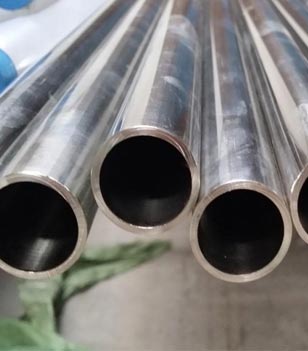
- SS 316 Pipe
- ASTM A312 TP316 Seamless pipes
- SS 316 Welded Pipe

Stainless Steel 316 Pipe
An ASTM specification used in the construction of austenitic grade SS pipes that are produced seamless, straight-seam welded, and cold worked welded is ASTM A312. While clients may prefer using a SS 316 seamless pipes for smooth and unrestricted flow, producing them require them to be heated using a certain heating parameter.

The ASTM A312 specification lists requirements for the furnishing based on the heat treating temperature as well as the cooling/testing parameters. On the other hand, a cold working a UNS S31603 pipes results in a much stronger, much tougher alloy. The surface of these pipes tend to become much smoother and since the crystalline microstructure of the alloy for 316 SS seamless pipes has been changed permanently, due to application of mechanical stresses, there is an increase in its tensile strength. Another advantage of using cold worked ASME SA312 grade 316 pipes is that they are dimensionally stable.
Hence these pipes are seen in industries such as oil and gas as well as petrochemical industry, where toughness, tensile strength and good dimensional stability are three important characteristics required for the application to succeed. However, the aisi 316 pipes size is dependent on the application itself. The purpose of using ASTM A312 tp 316 seamless pipes is in those industries which have requirements for general corrosion resistance properties. In addition to this, importance is also placed on the SS 316 Pipes to be able to withstand temperature at elevated service.
Stainless Steel 316 Pipe Material Specification
| Specifications of Stainless Steel 316 Pipe | American Society for Testing and Materials A 312 American Society of Mechanical Engineers SA 312 / American Society for Testing and Materials A 358 American Society of Mechanical Engineers SA 358 |
| ASTM A312 TP316 Seamless Pipes Dimensions | American Society for Testing and Materials, American Society of Mechanical Engineers and American Petroleum Institute |
| SS UNS S31600 ERW Pipes | 1/2 Inch To 16 Inch |
| Stainless Steel UNS S31600 Welded Pipes | 1/2 Inch To 24 Inch |
| Stainless Steel 316 ERW Pipes | 6 Inch To 100 Inch |
| Schedule | Schedule20, Schedule30, Schedule40, STD, Schedule80, Schedule60, Schedule80, Schedule120, Schedule140, Schedule160 |
Ready Stock of ASTM A312 TP316 Seamless Pipe


- SS UNS S31600 Pipes
- Stainless Steel 316 ERW Pipes
- TP316 SS Welded Pipe
Chemical Analysis of SS UNS S31600 Pipe
| Grade | Carbon (C) | Manganese (Mn) | Silicon (Si) | Phosphorus (P) | sulphur (S) | Chromium (Cr) | Molybdenum (Mo) | Nickel (Ni) | Nitrogen (N) | |
| 316 | Minimum | – | – | – | – | 16.0 | 2.0-3.0 | 10.0 | – | |
| Maximum | 0.035 | 2.0 | 0.75 | 0.045 | 0.030 | 18.0 | 14.0 | – |
ASTM A312 TP316 SS Welded Pipe Mechanical Properties Tensile Strength
| Grade | Tensile Strength | High Yield Strength | Elongation | Hardness | |
| Rockwell B maximum | Brinell (HB) maximum | ||||
| Stainless Steel 316 Pipes | 515 | 205 | 40 | 95 | 217 |
316 pipe allowable pressure on various temperatures
Maximum allowable working pressure or shortened as MAWP is referred to as the maximum pressure at which the weakest point of the system, equipment, or a vessel can handle at a specified temperature when in operating in typical applications. The MAWP is an important factor that is mandatory to be stated on all piping as well as vessels. In fact, the MAWP is a manner which could be used to determine the safe internal or external pressures which any equipment can withstand. The MAWP can be calculated by the following equation -
P = 2 x Sy x Fd x Fe x Ft x t / do
The P in the above equation indicates the MAWP value in psi, while Sy indicates the yield strength (or tensile strength) of the material, which in this case is stainless steel grade 316, Fd indicates the design factor, Fe corresponds to the longitudinal joint factor, Ft to the temperature derating factor and lastly, do is associated with the interior pipe diameter.